
Assign
Assign work to the SHIP agent on an issue
Work starts the moment you assign the issue. Delegate work to your agent fleet and walk away.
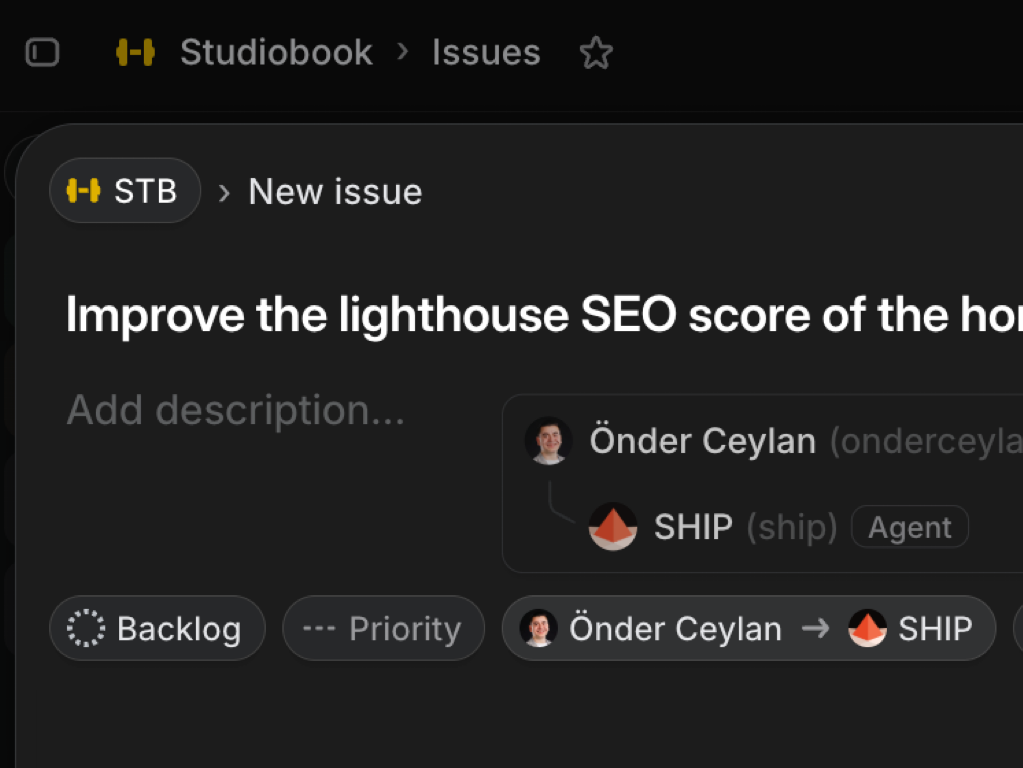
Assign an issue to SHIP. Agent team of specialists autonomously covers your SDLC, following your engineering practices, verifying, proving, and reporting every change.
For teams shipping software with coding agents.

 Pi
Pi
Agents already write a growing share of your production code. It lands faster than teams can verify its quality or account for its cost.
Teams pick their own agents, tools, and models, and nothing connects that choice to what ships or the uneven quality it ships at.
As agent adoption grows, that gap becomes unreviewed code, unpredictable spend, and outcomes no one can attribute. This is where teams lose control of quality and cost.
more review effort is spent checking AI-generated code, yet delivery outcomes improve only marginally.
Faros AI, 10,000+ developers across 1,255 teamscost difference for the same task depending on the AI models and tools used.
Artificial Analysis Coding Agent Index, 2026: 23 harness x model stacks on 321 tasksOperate AI agents that review and test as fast as they build, so work ships while your engineers stay in control.
Monitor every step, compare performance, and optimize AI costs confidently.
Run missions on the models, tools, and AI contracts your organization already uses.
SHIP is the only platform that runs coding agents like your team and proves what they ship and cost.
Operate your fleet of AI agents for bringing software to production while your engineers stay in control.
Assign
Work starts the moment you assign the issue. Delegate work to your agent fleet and walk away.
Collaborate
Steer the work in the thread you are already in. Ask for a follow-up, or get a mission report.
Stay in the loop
Each stage reports back as it completes, so you read progress where you already track it.
Your agent fleet collaborates on their shared mission. They navigate through the stages of your software development lifecycle.
Reads the ticket, repository, docs, and prior PRs. Surfaces ambiguity before anyone writes code.
Creates the implementation and testing plan the rest of the fleet ships against.
Writes the code in a sandbox. Runs your formatter, linter, typecheck, and tests, fixing failures before submission.
Reviews the diff against the plan and your project guidelines. Blocks critical issues, signs off on the rest.
Pushes to the PR, monitors CI, and runs your deployment pipeline out to an isolated preview.
Walks the happy path, then the unhappy ones. Validates acceptance criteria and shares proof of work.
Monitor missions in real time and see the outcome of each agent and model. Compare how they perform, and route the work to the stack that delivers best.
Mission detail
Open a mission to follow its timeline end to end. Read what each agent did on its turn, its cost, and its result.
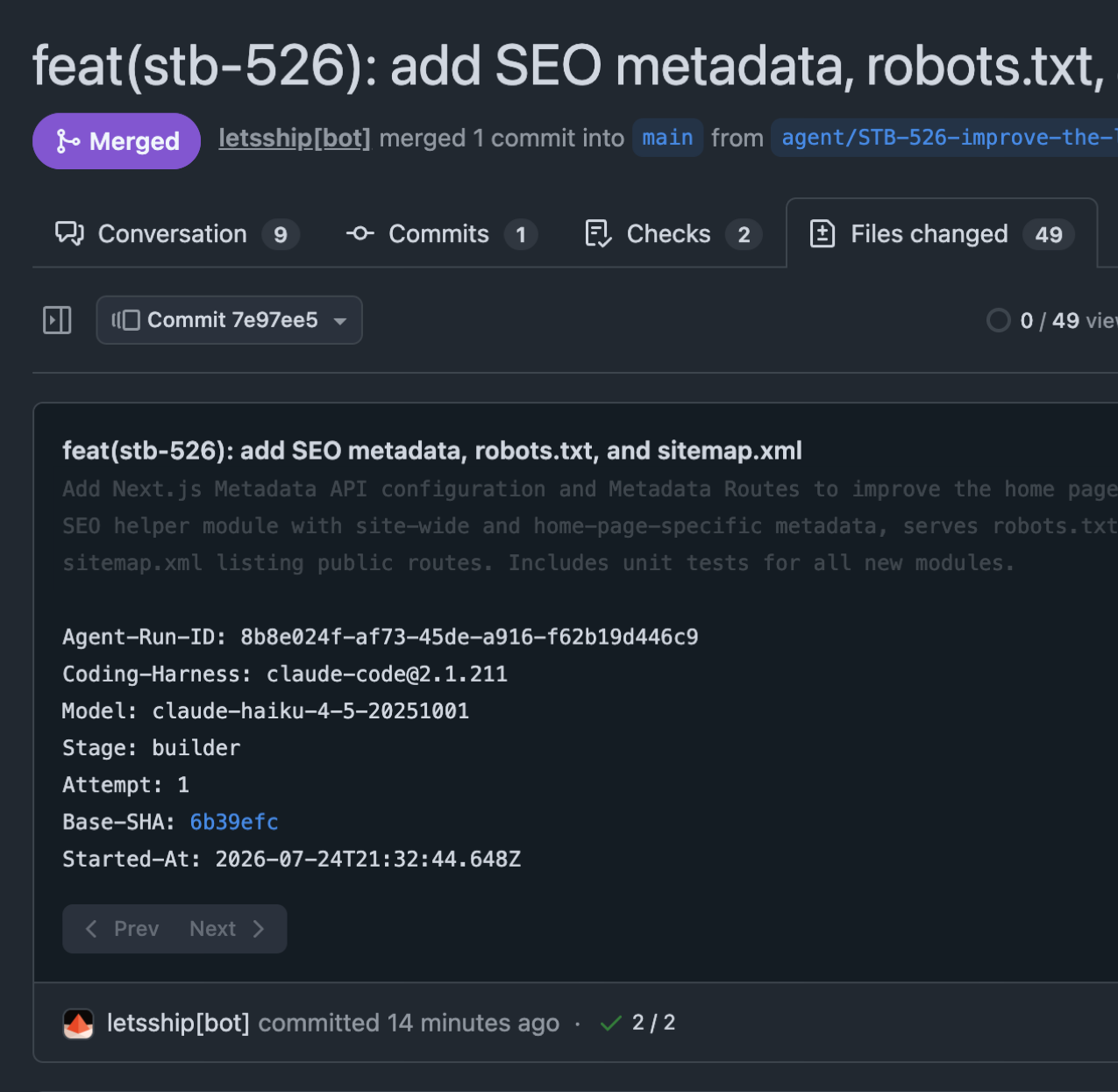
Verified PR
Every mission lands a pull request that already passed reviews and tests, with the agent identity on the record.
Proof of work
Screenshots, videos, and a test recording are the evidence attached to a completed mission. Accept or decline.
Cost optimization
Measure your spend against the work delivered, and reduce cost systematically.
| Stage | # of turns | Duration | Share | Cost |
|---|---|---|---|---|
| Plannerclaude-code/opus · 15.6k in · 7.8k out | 1 | 1m 47s | $0.351 | |
| Builderclaude-code/haiku · 29.3k in · 9.1k out | 1 | 5m 17s | $0.189 | |
| Reviewerclaude-code/opus · 96.5k in · 3.0k out | 1 | 49s | $0.687 | |
| QAclaude-code/sonnet · 43.1k in · 8.1k out | 1 | 3m 49s | $0.530 | |
| CI | 1 | 1m 10s | - |
From a real mission operated on SHIP. Actual duration and cost vary by project complexity, harness, model, and per-role agent configuration, and lead time depends on acceptance speed.
Compare and choose
AI sovereignty
Run missions on the models, tools, and AI contracts your organization already uses.
Your contracts and keys
Connect your own provider accounts. Inference runs at your own contracted rates, directly on your account.
 glm
glm Pikimi
Zero-trust security model
Agents run in an isolated sandbox and never receive your keys. An agent can access only what the task needs, and the platform attaches your credential at the network edge.
Your keys never enter the sandbox: the request carries a placeholder, and the platform swaps in your real key at the network edge. Capability-based access is granted when necessary over a short-lived, scoped token.
Data governance
Your provider accounts, contracts, and regions decide where inference runs. The session data that powers your logs, metrics, and audit trail is held under SHIP's own security controls.
* Compliance in progress.
Start shipping faster and cheaper as soon as you onboard. SHIP lets your whole team deliver without learning anything new.
Your agentic engineering system
Use the agents, skills, MCP servers, project memory and tools your team already built.
Your issue tracking system
File the issues in your existing projects as you're assigning them to a new team member.
Your repositories and pipelines
Completed work ships to your existing repositories using your CI/CD, following your own SDLC model.
What SHIP adds
The operating system for agentic engineering, running on your terms.
Contact us for a demo with an expert.